Description
Overview
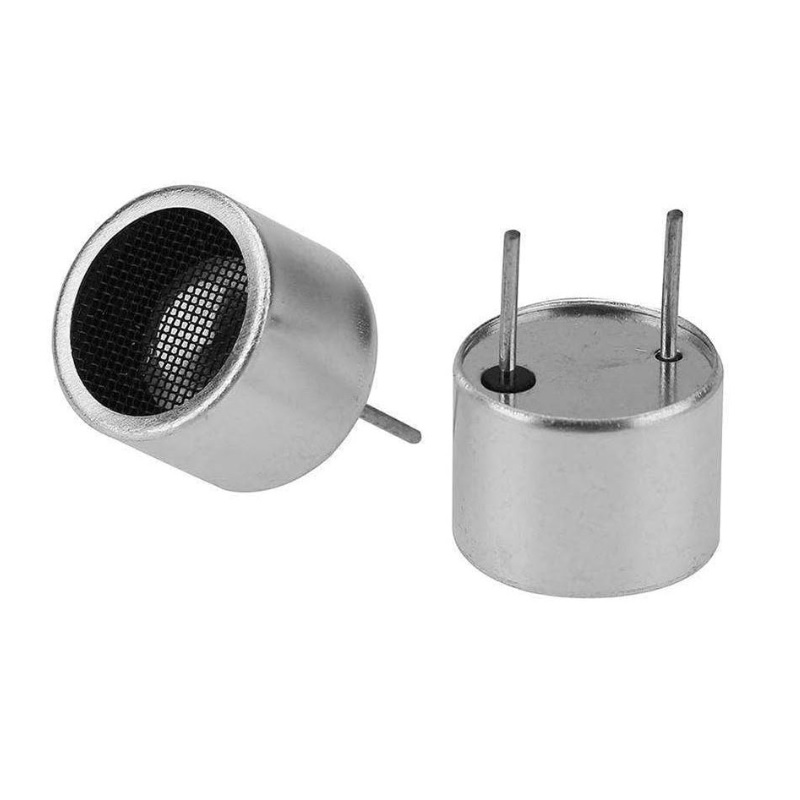
This 25 kHz air-coupled ceramic ultrasonic transducer is designed for transmitting and receiving ultrasonic acoustic signals through air. Its compact 16 mm diameter housing makes it suitable for ultrasonic sensing, object detection, distance measurement, and other acoustic applications.
The transducer operates around the 25 kHz ultrasonic frequency, providing a practical solution for applications where a lower ultrasonic frequency is preferred over commonly used 40 kHz sensors. Similar 16 mm commercial transducers are available in dedicated transmitter and receiver versions.
Key Features
- Center / resonant frequency: 25 kHz
- 16 mm nominal diameter
- Air-coupled ultrasonic operation
- Ceramic piezoelectric construction
- Compact metal housing
- Suitable for ultrasonic transmission or reception
- Suitable for distance and object detection applications
- Wide 85° beam angle for compatible 16 mm commercial versions
- Suitable for robotics and automation projects
Technical Specifications
| Parameter |
Specification |
| Type |
Air-Coupled Ceramic Ultrasonic Transducer |
| Frequency |
25 kHz |
| Diameter |
16 mm nominal |
| Typical External Diameter |
16.2 mm |
| Beam Angle |
85° |
| Construction |
Piezoelectric Ceramic |
| Housing |
Metal / Aluminum |
| Mounting |
Through-Hole |
| Medium |
Air |
| Application |
Ultrasonic transmission / reception |
Commercial 16.2 mm 25 kHz versions such as the PROWAVE 250ST160 transmitter specify an 85° beam angle, while the corresponding 250SR160 receiver has a 25 kHz resonant frequency and 2 kHz bandwidth.
Applications
- Ultrasonic distance measurement
- Object detection
- Proximity sensing
- Robotics
- Industrial automation
- Security systems
- Obstacle detection
- Acoustic sensing
- DIY ultrasonic projects
- Educational electronics projects
- Custom ultrasonic transmitter/receiver systems
What’s Included
- 1 × 25 kHz Air-Coupled Ceramic Ultrasonic Transducer
- Nominal diameter: 16 mm
Notes
- This is an air-coupled ultrasonic transducer, not an ultrasonic cleaning transducer or underwater transducer.
- Please confirm whether your specific part is the transmitter (TX) or receiver (RX) version before publishing electrical specifications such as impedance, sensitivity, maximum drive voltage, or capacitance.
- The 16 mm specification refers to the nominal transducer diameter; commercially available versions may have an actual external diameter of approximately 16.2 mm.
- The transducer should be driven at or near its specified resonant frequency for optimum performance.
- TX and RX versions are not interchangeable for all applications; use the appropriate version for the intended circuit.






Reviews
There are no reviews yet.